West Germany 3-2 Hungary: the 1954 World Cup final
Ferenc Puskás puts Hungary ahead after six minutes, then Werner Kohlmeyer's back-pass leaves Toni Turek in trouble and Zoltán Czibor puts the ball into an empty net. Eight minutes gone in the World Cup final and West Germany are already 2-0 down.
And this was Hungary with Puskás, Sándor Kocsis and Nándor Hidegkuti. Olympic champions, England beaten 6-3 at Wembley and then thrashed 7-1 in Budapest. They'd already hammered West Germany 8-3 in the group stage. Two goals down against the best side in the world, another hiding on the cards.
But Max Morlock gets one back. Helmut Rahn sends a low ball across from the left, József Zakariás can't get it safely back to Gyula Grosics and Morlock reaches it in front of the keeper. Ten minutes played, 2-1.
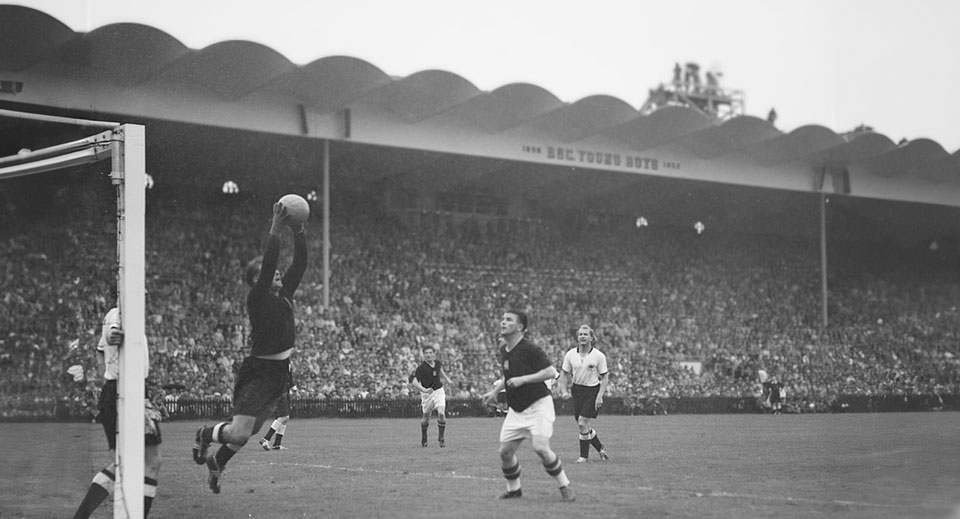
Before the final
The 8-3 group game needs a bit of explaining. Sepp Herberger had rested several of his first-choice players against Hungary. The format gave him a reason to risk it. Each team played only two group matches, and points decided the standings without goal difference. Herberger expected Germany and Turkey to finish level behind Hungary and have to play again for second place. He backed his strongest side to beat the Turks twice.
It worked. Germany won the first meeting 4-1 and the play-off 7-2. Then came a much harder 2-0 win over Yugoslavia. An Ivica Horvat own goal put Germany ahead after nine minutes, Turek kept them in it and Rahn settled it in the 85th. By the semi-final Herberger had the eleven he wanted. They beat Austria 6-1: Fritz Walter scored two penalties, Ottmar Walter also scored twice, and Hans Schäfer and Max Morlock got one each. Herberger kept the same side for the final. Five of those starters came from Kaiserslautern.
So Hungary were meeting a stronger German side this time. But that first match had cost Hungary something more serious than a misleading impression of their opponents. Puskás, their biggest star, had hurt his ankle in a challenge by Werner Liebrich, missed both the quarter-final and semi-final and came into the final still carrying the injury.
Hungary still beat Brazil 4-2 in the notorious Battle of Bern, with three players sent off and fighting after the match. Then they beat holders Uruguay by the same score after extra time. They'd let a 2-0 lead slip in that one too, before Kocsis scored twice late in the extra half-hour. By the final he had eleven goals: three against South Korea, four against Germany and two each against Brazil and Uruguay. Hungary had scored 25 in four games, winning 9-0, 8-3, 4-2 and 4-2, but getting past Brazil and Uruguay had taken plenty out of them.
Sebes brought Puskás back for the final in place of Péter Palotás. He also dropped right-winger László Budai, brought in Mihály Tóth on the left and moved Czibor across to the right. Restoring the captain meant changing an attack that had just beaten the world champions without him.
In the telephone interview published by Néplap on 6 July, Puskás explained that he had felt fit in training and when he tried his shooting before the game. At first there was no pain. After eight to ten minutes, though, he knew he wasn't fully fit. He had already scored in the sixth minute. The early goal had made the decision look a lot more comfortable than it really was.
Match telegram
· 1954 World Cup final · 4 July 1954West Germany 3:2 Hungary
Wankdorf-Stadion, Bern. Referee: William Ling, England.
Goals: 6′ Puskás 0:1. 8′ Czibor 0:2. 10′ Morlock 1:2. 18′ Rahn 2:2. 84′ Rahn 3:2.
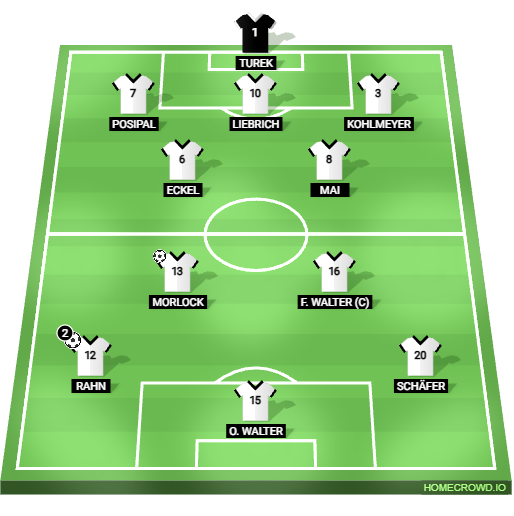
West Germany: Turek; Posipal, Liebrich, Kohlmeyer; Eckel, Mai; Rahn, Morlock, O. Walter, F. Walter, Schäfer.
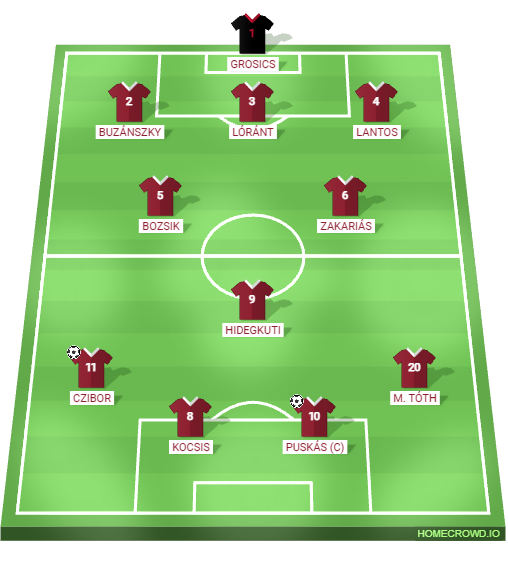
Hungary: Grosics; Buzánszky, Lóránt, Lantos; Bozsik, Zakariás; Czibor, Kocsis, Hidegkuti, Puskás, M. Tóth.
West Germany line-up
Herberger kept the side that had beaten Austria. Fritz Walter captained it, Morlock worked between midfield and attack, and Rahn and Hans Schäfer supplied the threat from the wings.
Hungary line-up
Gusztáv Sebes recalled Puskás and selected Tóth on the left. Czibor played on the right, with Kocsis attacking the box and Hidegkuti coming back towards the midfield.
Back to 2-2
Fritz Walter puts a corner into the Hungarian area and Rahn arrives at the far post to turn it in. Eighteen minutes gone and the two-goal lead has disappeared.
Germany had dragged themselves level, but there was still a problem with the way Hungary played. Hidegkuti wore nine, yet he didn't stay up waiting between the centre-backs. He came back to get the ball. Defenders had a choice: follow him and leave space for Puskás and Kocsis, or stay put and let him turn. England had found out at Wembley what happened when they couldn't get to grips with him. He scored three.
Herberger gave Horst Eckel the job of following him. Eckel was a half-back with the legs to go into midfield with Hidegkuti, so Liebrich didn't have to chase the Hungarian number nine all over the place. It was a way of dealing with the movement that had made Hungary so difficult to mark.
Horst Eckel on his partnership with Fritz Walter:
Fritz Walter war der Kopf
Fritz Walter was the brains.
Eckel added that he did the running for him.
Germany still didn't have Hungary under control. Before the break Hidegkuti gets on the end of a knock-down and hits a volley that Turek keeps out. Even with Eckel close by, Hungary could still find their number nine within shooting distance.
The second half
Hungary keep coming. Tóth gets a shot past Turek and Kohlmeyer clears off the line. Then Tóth crosses and Kocsis heads against the bar. The tournament's leading scorer, whose two headers had won the semi-final, is close to putting Hungary back in front.
Turek stops Puskás with his foot. Somebody blocks a shot, somebody reaches a loose ball, and Germany have to set themselves for the next attack.
The goalkeeper who had been caught out for Czibor's goal was keeping Germany in the game. Herbert Zimmermann went wild on German radio, calling Turek a football god. Carlos Pardo, filing his report from Bern for Mundo Deportivo, was scarcely less impressed.
Carlos Pardo, reporting from Bern:
Turek, un portero que lo paró todo.
Turek, a goalkeeper who stopped everything.
But Germany could play their way forward as well. Pardo picked out their short passing and the work Fritz Walter and Morlock did in both directions. They weren't just booting the ball away and hoping. Those two could help the defence, then give Germany a pass out, and Rahn was still a danger when they found him.
The rain was pouring down and the Wankdorf pitch was heavy. Germany wore Adidas boots with screw-in studs. A practical advantage in those conditions and a huge moment for the company. Adidas understandably makes much of it in its own history.
Rahn's winner
With six minutes left Schäfer gets the ball on the left and crosses. Hungary don't clear it far enough. It drops to Rahn outside the box, he moves inside onto his left foot and drives a low shot across Grosics into the corner. 3-2 Germany.
The right-winger had scored the equaliser from a corner and now he'd won the final with his left foot. He'd also scored the late second goal against Yugoslavia. When Germany needed somebody to finish a game, Rahn kept turning up.
Soon afterwards Puskás gets through and puts the ball into the net. Hungary celebrate the equaliser, but the goal is ruled out for offside. Germany are still 3-2 up.
The decision has been argued over ever since. In a telephone interview printed in Néplap two days later, Puskás said his teammates and the officials around the team believed the goal should have stood.
Ferenc Puskás after the final
Was the disallowed equaliser valid?
"I don't know whether it was offside." [Answer excerpt.]
After the final
West Germany had won at their first World Cup since the war. The win became known as the Miracle of Bern, and Zimmermann's voice became part of how the country remembered it. There was a bit of luck in his being at the microphone at all. Kurt Brumme had won the draw to cover Germany's opening game, and the commentators took turns after that, which left Zimmermann with the final.
Hungary went home with 27 goals from five matches, eleven of them from Kocsis, and runners-up medals. The questions over Sebes's selections began straight away. On 6 July Népsport editor László Feleki argued that Hungary had won their hardest games without Puskás and that the attack had started to come together against Uruguay. Bringing the captain back had disrupted that. Feleki also warned against blaming everything on the team selection. That is a more useful argument than simply saying Hungary had been too confident.
The defeat didn't immediately finish Sebes or his team. He remained in charge until 1956. The revolution that year and the departure of players including Puskás, Kocsis and Czibor eventually broke up the great attack.
Kocsis and Czibor later came back to Wankdorf with Barcelona for the 1961 European Cup final. Both scored. Benfica beat them 3-2.
References
- West Germany 3-2 Hungary: final match record - DFB Datencenter. Date, venue, referee, both starting XIs, shirt numbers and goals. The match telegram uses DFB's goal minutes; contemporary and later sources sometimes number them differently.
- World Cup 1954: full tournament record - RSSSF. Results, captaincy and the play-off format. Its team-list separators differ from other records and should not be read as a definitive tactical diagram.
- West Germany 2-0 Yugoslavia: quarter-final match record - DFB Datencenter. Horvat's own goal in the ninth minute and Rahn's second in the 85th.
- West Germany 6-1 Austria: semi-final match record - DFB Datencenter. Two goals each for Fritz and Ottmar Walter, both of Fritz's from penalties; one each for Schäfer and Morlock. The same German XI started the final.
- Magical Magyars' incredible goal haul - FIFA, 16 December 2024. Hungary's 25 goals before the final and 27 overall; Kocsis's three against South Korea, four against Germany and two each against Brazil and Uruguay.
- Berni tragédia - Puskás Institute, 4 July 2023. Both XIs, Hungary's 27 goals and Kocsis's eleven.
- 70 éves vb-ezüst - Puskás Institute, 4 July 2024. Sebes's changes, the wing positions and the Hungarian account of Grosics being obstructed at 2-2.
- WM 1954: Das Wunder von Bern - DFB, 22 May 2026. Herberger's group-stage plan, the Kaiserslautern players and Germany's knockout matches.
- The day magic wowed Wembley - FIFA, 25 November 2023. Hungary's Olympic title and the two wins over England.
- 1954: Hungary reach their peak - UEFA. The Brazil and Uruguay matches and Turek's final save from Czibor.
- Das Wunder von Bern - Horst Eckel's official website. His later recollection of playing alongside Fritz Walter and following Hidegkuti. The English quotation is translated from German.
- Die Neue Fußball-Woche archive - Ernst Molnos, issue 27, 6 July 1954, pp.3-4. Match report, Morlock's goal, Hungarian chances, Rahn testing Grosics and the contact between Schäfer and Bozsik before the winner. Original printed pages inspected; the archive requests links to its landing page.
- Carlos Pardo's report from Bern, front page and continuation on p.5 - El Mundo Deportivo, 5 July 1954. Turek, Germany's passing and the work of Walter and Morlock. The quoted English line is translated from Spanish.
- Puskás beszél and the neighbouring match report - Néplap, Hajdú-Bihar, 6 July 1954, p.4. Printed telephone Q&A from Solothurn, stated conversation time Tuesday 00:15. Fitness, offside, the unseen film and replay rumours. The interview component contains a translated question and a short answer excerpt, not the full reply.
- Rahn's World Cup boot recalls the Miracle of Bern - German Football Museum, 4 July 2014. Rahn's left-footed winner and the boot loaned by his sons.
- The history of Adidas: 1954 and the Miracle of Bern - Adidas's account of its boots and removable studs. A manufacturer's retrospective, not an independent explanation of the result.
- Herbert Zimmermann: from reporter to the voice of Bern - WDR, 29 November 2012. His commentary, the description of Turek and the allocation of the final.
- A magyar sport aranykora, a Nemzeti Sport fénykora - Gábor Thury, Nemzeti Sport / Képes Sport, 18-19 March 2023. Reproduces Feleki's 6 July 1954 criticism and records his dismissal. This is the paper's later archive account, rather than an independently inspected original issue of Népsport.
- Minden kezdet nehéz - Puskás Institute. Sebes's tenure through 1956.
- Az FC Barcelona kupadöntős hőse - Puskás Institute, 24 June 2024. Kocsis, Czibor and Puskás's departure after the 1956 uprising. Benfica end Madrid's golden age and 1961 final venue - UEFA. Kocsis and Czibor scoring in another 3-2 defeat at Wankdorf.
- 1954 final: goals and highlights - FIFA's official archive. Further viewing; these highlights are not used here to adjudicate the offside decision.
- [1] Turek and Hungary's forwards at Wankdorf - ETH-Bibliothek Zürich, Bildarchiv / Comet Photo AG (Zürich), Com_M03-0108-005-0011, 4 July 1954. CC BY-SA 4.0. Existing cropped derivative; the archive identifies the scene as first-half action.